

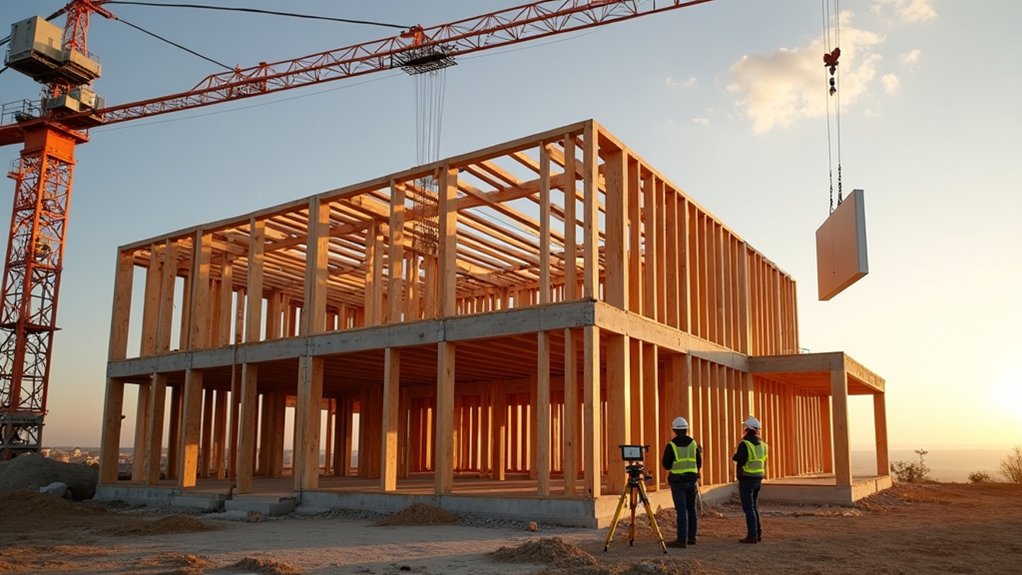
On a recent modular mid-rise, you can watch a laser scan flag a 6 mm misalignment before a single bolt’s torqued, like a blood test catching risk early. You’re shifting structural reliability from on-site improvisation to controlled manufacturing, BIM-driven clash avoidance, and repeatable connection detailing. You get tighter tolerances, documented QA/QC, and traceable materials that reduce hidden variability in load paths. But transport, lifting, wind, seismic, and fire still introduce edge cases that can undo the gains if you don’t account for them…
What Are Modern Building Methods (MMC)?
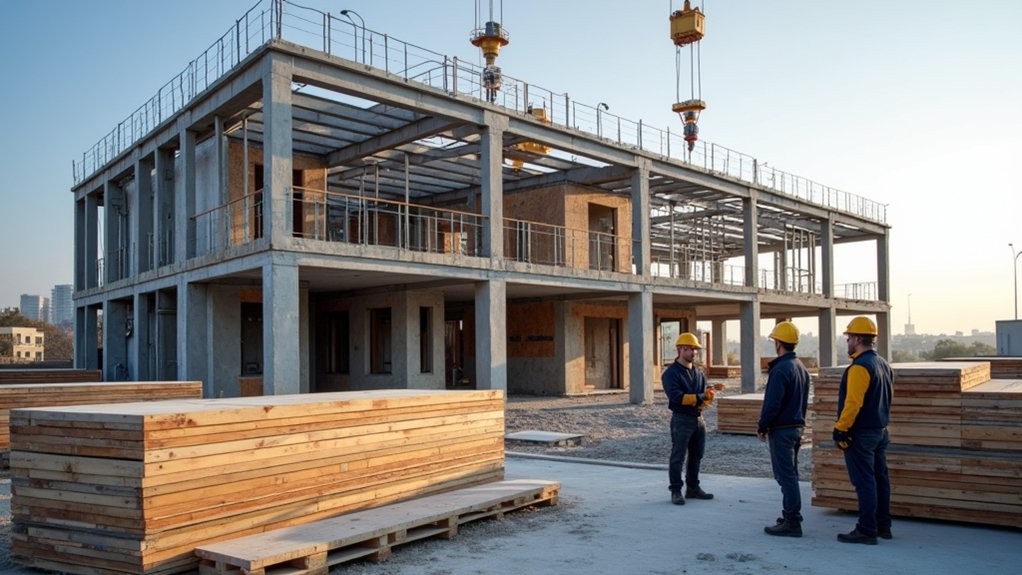
Although the term varies by region and standards body, Modern Methods of Construction (MMC) generally refer to building approaches that shift labor and quality control from the open site to controlled manufacturing and digitally planned assembly. You typically see MMC grouped into offsite volumetric modules, panelized systems, and componentized sub-assemblies, all coordinated through BIM-derived tolerances and logistics planning.
You’ll evaluate MMC by its manufacturing content, interface definition, and repeatability rather than by architectural style. Innovative materials—such as high-performance concretes, engineered timber, and cold-formed steel—often pair with factory automation, CNC cutting, and standardized connection details.
Modular assembly then becomes a sequencing problem: transport limits, crane picks, and service integration drive design decisions. You also track MMC through certification pathways, traceability records, and documented process controls.
How MMC Improves Structural Reliability (Core Mechanisms)
MMC’s value isn’t limited to faster delivery; it improves structural reliability by tightening variability in materials, geometry, and connections. You achieve this by shifting design and delivery toward data-controlled processes: parametric modeling, coordinated detailing, and repeatable work instructions that reduce human-induced scatter.
You also strengthen reliability through earlier structural coordination, so load paths, tolerances, and interface forces are resolved before procurement, limiting late changes that introduce defects.
When you specify Sustainable materials with verified grades, traceability, and documented moisture or curing limits, you reduce uncertainty in stiffness, strength, and durability. You then use staged inspections, digital QA records, and acceptance criteria tied to design assumptions, improving statistical confidence in performance.
These controls support Cost efficiency by cutting rework and contingency without lowering safety margins.
Factory-Built Components: Tighter Tolerances, Fewer Defects
When you shift critical structural work into a factory setting, you control tolerances and defect rates far more tightly than you can on an exposed, variable site. You standardize jigs, calibration, and curing conditions, so dimensional variance drops and load paths match design assumptions.
You also implement statistical process control, traceable batch records, and non-destructive testing, catching voids, poor welds, and fastener mis-torque before shipment.
On site, you’re assembling verified parts, not improvising fixes under weather and schedule pressure. That improves Prefabrication safety by reducing rework at height and limiting hot works.
It also supports Modular innovation: repeatable modules let you refine details across iterations, quantify defect trends, and lock in proven tolerances, raising reliability across entire building programs at scale.
BIM Coordination: Fewer Clashes and Field Fixes
Because BIM federates structural, MEP, façade, and fit-out models into a single coordinated geometry set, you can detect and resolve clashes digitally instead of discovering them during installation. You run rule-based clash detection against tolerance bands, access zones, and code-driven clearances, then issue tracked design actions before procurement locks.
With Digital workflows, you standardize object libraries, naming, and model exchange (IFC/CDE), which reduces translation errors that often trigger ad‑hoc rework. You also quantify residual risk: clash counts by system, severity scoring, and closure rates become leading indicators of constructability.
Innovative collaboration improves reliability when engineers, fabricators, and installers review the same federated model in timed coordination cycles, so interface assumptions get validated and documented, not improvised. That traceability strengthens QA and change control across revisions.
Site Fit-Up: Tolerances, Lifting, and Temporary Bracing
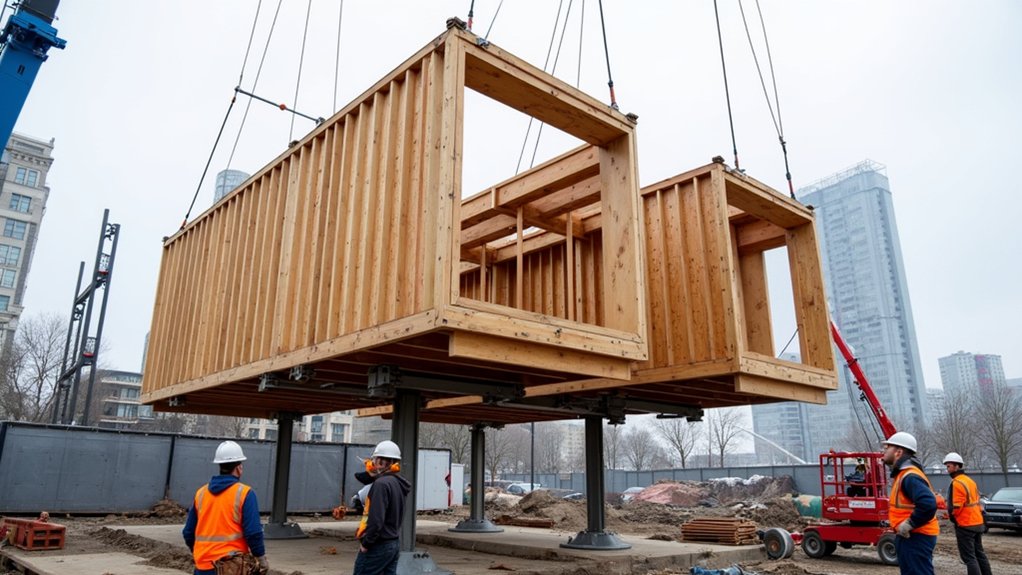
A coordinated BIM model reduces interface uncertainty, but structural reliability still gets decided in the fit-up: whether the delivered geometry, site datums, and erection sequence stay within the tolerance stack-up you assumed. You verify as-built plumbness, bearing elevations, and anchor locations before unloading, because small deviations amplify through modular grids.
You plan lifting points, rigging angles, and pick sequences to control dynamic effects and prevent local overstress. You also align site logistics—crane reach, laydown space, access routes—so components don’t wait and distort.
Temporary bracing must reflect real wind exposure, construction-stage eccentricities, and diaphragm readiness, not final-state assumptions. If you monitor brace forces and survey drift during erection, you’ll confirm foundation stability and keep geometry within measurable limits, avoiding field rework and schedule-driven shortcuts.
Connection Design: Keeping Load Paths Continuous
Even if your modules meet fabrication tolerances, the connections still decide whether gravity and lateral forces flow through the structure without unintended eccentricity or discontinuity. You need a deliberate force path from slab or diaphragm, through collectors, into walls, frames, and foundations, with no “missing” members at interfaces.
Design for connection integrity by aligning centroids, minimizing prying, and controlling slip with pretensioned bolts, welded continuity plates, or mechanical couplers sized for combined shear, tension, and moment.
You’ll preserve load continuity when you check stiffness compatibility, not just strength, so differential shortening and diaphragm flexibility don’t concentrate demand.
Detail robust bearing, shims, and tolerable rotations so erection-induced misalignment doesn’t trigger secondary bending.
Treat connections as structural elements, not accessories.
QA/QC for MMC: Inspection, Testing, Traceability
In QA/QC for MMC, you’ll reduce structural uncertainty by enforcing standardized inspection protocols at each production and installation hold point.
You’ll pair that with traceability—unique IDs tied to material certs, process parameters, and as-built geometry—so you can verify conformance and isolate nonconformities fast.
You’ll then lock reliability in with testing controls (sampling plans, calibrated equipment, and acceptance criteria) that demonstrate performance against design assumptions rather than relying on visual checks alone.
Standardized Inspection Protocols
Because modern methods of construction shift much of the work from the site to controlled factory environments, you can’t rely on traditional site-centric checks to guarantee structural reliability; you need standardized QA/QC inspection protocols that follow the product through design release, fabrication, transport, and installation.
You specify measurable acceptance criteria for geometry, tolerances, fastener torque, weld profiles, seal continuity, and moisture protection, aligned to codes and project performance requirements.
You use hold points, witness points, and independent verification to reduce subjective sign-off.
With innovative materials, you standardize surface preparation, cure windows, and interface compatibility checks.
Digital integration helps you issue controlled inspection plans, enforce revision control, and capture nonconformance trends for corrective action.
You also standardize installation checks so site crews replicate factory intent under variable conditions.
Traceability And Testing Controls
Standardized inspection protocols only hold up when you can prove which exact materials, components, and processes they covered, so traceability and testing controls become the backbone of MMC structural reliability.
You lock this in by assigning batch IDs, digital product passports, and torque/temperature logs to every module, then linking them to as-built models.
You verify compliance through incoming material certification, in-process dimensional checks, and witness testing for welds, adhesives, and fasteners.
You reduce rework by setting acceptance criteria, sampling plans, and nonconformance workflows that trigger root-cause analysis.
Material innovation increases variability, so you validate new composites or low-carbon mixes with coupon tests and statistical process control.
Done right, your sustainability practices stay auditable, and field performance matches factory intent, consistently.
When MMC Needs Extra Engineering (Wind, Seismic, Fire, Transport)
You can’t rely on standard MMC details when wind and seismic demands introduce higher lateral forces, drift limits, and connection cyclicity that exceed typical module assumptions.
You need extra engineering to verify load paths through diaphragms, ties, and inter-module joints, and to demonstrate fire resistance where compartmentation, penetrations, and joint detailing govern performance.
You also have to design for transport constraints—lifting points, temporary bracing, vibration, and geometric tolerances—because handling loads can control member sizing and connection robustness before the building ever sees service loads.
Wind And Seismic Loads
While modern methods of construction (MMC) often deliver predictable performance under routine design actions, wind and seismic loads can push modular and panelized systems into response regimes where assumptions about stiffness, ductility, and load paths no longer hold. You’ll see higher demand on diaphragms, inter-module connectors, and hold-downs, where slip, uplift, and cumulative damage govern.
In Modular construction, stacked tolerances and discontinuous shear walls can amplify torsion and create soft-storey behavior unless you detail a continuous lateral system. You should verify connection hysteresis, overstrength factors, and drift compatibility with façade and MEP restraints using nonlinear time-history or response-spectrum checks where codes trigger.
Innovative materials help, but you must qualify damping, strain-rate effects, and long-term stiffness loss through testing and QA.
Fire And Transport Constraints
Because MMC concentrates fabrication off-site and then compresses assembly into short on-site windows, fire performance and transportability often become the governing constraints rather than gravity design. You’ve got to prove fire safety at the module level: lining continuity, protected connections, cavity barriers, and verified compartmentation across joints that move under tolerance and shrinkage.
You’ll often need tested assemblies or engineered equivalents, because partial encapsulation and exposed services can undermine ratings. Transport logistics then drive structural and durability detailing: lifting frames, racking resistance during haulage, vibration fatigue at bolted joints, and temporary bracing that doesn’t damage finishes.
Road width, bridge limits, and escort rules cap module size, so you may split volumes and re-create diaphragms and fire stops on-site, adding interfaces that demand extra QA/QC and inspection points.
Frequently Asked Questions
How Do MMC Projects Affect Building Insurance Premiums and Underwriting Requirements?
MMC projects can lower premiums if you prove compliance with building codes and supply robust risk assessment data. You’ll face stricter underwriting on fire performance, moisture control, warranties, QA records, and long-term maintenance plans.
What Financing or Mortgage Challenges Arise With Offsite-Manufactured Construction?
You’ll face lender caution on appraisals, warranty verification, and staged inspections because offsite value sits in factories. Construction costs may front-load, stressing draw schedules. Financing options can narrow, requiring specialist lenders, higher deposits, contingencies.
How Does MMC Influence Long-Term Maintenance Schedules and Repair Accessibility?
You’ll love MMC: it “magically” standardizes Maintenance scheduling via documented modules and predictable service intervals. Modular durability reduces lifecycle defects, but repair accessibility depends on planned service voids, demountable joints, and verified as-built BIM data.
Are Replacement Parts Available Decades Later for Proprietary MMC Systems?
Replacement parts aren’t guaranteed decades later for proprietary MMC systems; you’ll depend on the Supply chain and manufacturer survival. You can mitigate risk by specifying Legacy components, open standards, documented interfaces, and approved retrofit kits.
What Is the Resale Value Impact of MMC Compared to Traditional Builds?
MMC can match or slightly outperform traditional resale if you document certifications and performance. Buyers price in Material durability and Design flexibility; uncertainty about proprietary components can discount value. You’ll reduce risk via warranties, surveys.