

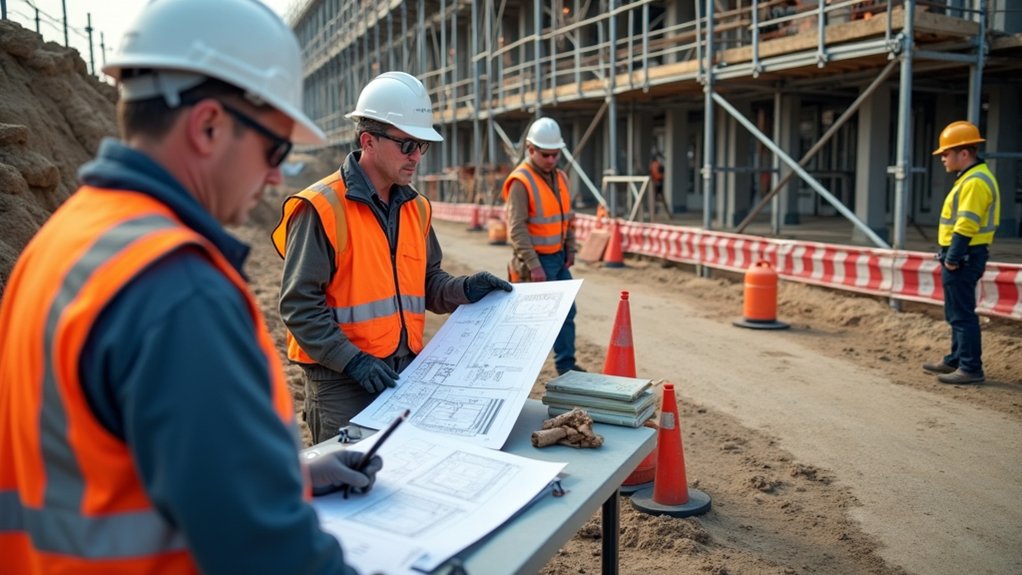
You don’t get much room for improvisation once on-site health and safety standards enter the picture. You map where rules affect layout, access, traffic control, and fall protection before you set phasing. You run a preconstruction JHA/PTP to identify controls that drive permits, inspections, training, and equipment selection. You also sequence high-risk tasks around required protections and align subcontractors to one enforceable plan—because one missed requirement can halt work when you least expect it…
Map Where Construction Safety Standards Affect Planning
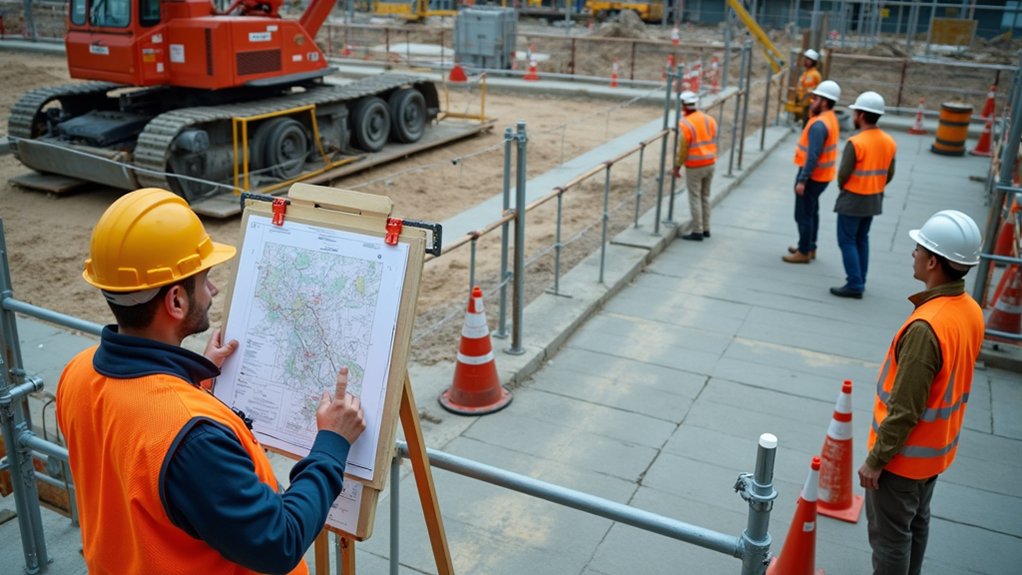
Before you finalize the site layout or construction schedule, you need to map exactly where safety standards impose design and sequencing constraints. Identify code-driven setbacks, access routes, and controlled zones for lifting, hot work, and confined spaces. Then align them with logistics and trade stacking.
You’ll designate protected pedestrian paths, barricade lines, and exclusion perimeters. You’ll also document required clearances around electrical panels, excavations, and edge protection. Specify Safety signage locations at all entries, hazard interfaces, and changing traffic patterns.
Tie installation dates to mobilization milestones. Define Emergency protocols that affect planning: muster points, ambulance access, fire water supply, alarm audibility, and temporary lighting.
Verify responsibilities, inspection frequencies, and permit triggers in your planning baseline.
Run a Preconstruction Hazard Assessment (JHA/PTP)
Once you’ve mapped where safety standards constrain the site plan and schedule, you need to validate the actual work methods against those constraints by running a preconstruction hazard assessment (JHA/PTP).
You’ll break each scope into discrete tasks, define tools and materials, and confirm interface points with other trades. Perform hazard identification by walking the workface, reviewing drawings, lift plans, equipment specs, and SDSs, then listing credible energy sources, access hazards, and exposure routes.
Assign severity and likelihood, document existing controls, and specify risk mitigation measures using the hierarchy of controls, with clear owner and verification steps. You’ll also set hold points for field confirmation, align sequencing with control installation, and require supervisor sign-off before mobilization.
Update the JHA/PTP when conditions change.
Lock In Permits, Training, and Required Inspections Early
You need to lock in an early permit strategy by identifying jurisdictional requirements, lead times, and submission packages before mobilization so work doesn’t start out of compliance.
You should front-load safety training by verifying required certifications (e.g., OSHA, confined space, fall protection) and documenting competency sign-offs before assigning tasks.
You must schedule mandatory inspections early—pre-pour, scaffold, crane, electrical, and fire/life-safety as applicable—and align hold points with the project schedule so you don’t miss statutory checks.
Early Permit Strategy
How early can you lock in permits, mandated training, and inspection windows without disrupting the build sequence? Start at schematic design: map jurisdictional lead times, identify critical-path approvals (grading, utility, structural, crane, hot work), and assign each to a responsible party with submittal dates.
Drive permit acquisition by freezing code-triggering scope early—occupancy, egress, fire protection, and temporary works—so reviewers don’t reopen comments midstream.
Build safety compliance into the permit matrix: note required plans (JSAs, traffic control, fall protection, SWPPP), documentation format, and posting rules.
Pre-book inspections tied to hold points (rebar, welds, pressure tests, firestopping) and integrate them into the CPM schedule with float.
Keep a change-control gate: no field start until prerequisites clear.
Front-Load Safety Training
Before the first crew mobilizes, front-load safety training and tie it directly to your permit and inspection matrix so compliance doesn’t drift into “catch-up” mode. Map each permit condition to task-specific competencies (confined space, hot work, excavation, silica, LOTO) and require completion before badge activation or tool issuance.
Build hazard communication into onboarding: verify SDS access, label protocols, and crew understanding of chemical exposure controls and reporting thresholds. You’ll strengthen Safety culture by assigning accountable trainers, documenting rosters, and capturing fit-testing, medical clearances, and equipment qualifications in a centralized LMS.
Pre-brief subcontractors on site rules, stop-work authority, and required JHAs so their mobilization packages match your permits and planned work methods. Align refresher intervals to project phases and shift changes.
Schedule Mandatory Inspections
Once the permit register and training matrix are set, lock in mandatory inspections on the project schedule so prerequisites don’t slip into field-driven “workarounds.” Tie each permit condition and high-risk activity (excavation, confined space, hot work, crane/rigging, temporary power, silica controls) to a required inspection type, frequency, and competent-person signoff, then assign responsible parties and due dates in your lookahead plans.
Use inspection scheduling gates to prevent task release until permits are active, pre-task briefings are logged, and controls are installed.
Build compliance tracking into daily reports: capture checklists, photos, instrument readings, and corrective-action closeout times. Coordinate AHJ and third-party visits early, and include lead times for lab results and equipment certifications.
If an inspection fails, replan immediately and document stop-work authority.
Plan Site Layout for Access, Traffic, and Fall Protection
You must map access routes and egress points before mobilization, keep them unobstructed, and post required signage so emergency response and daily work comply with site-specific plans.
You’ll control site traffic flow with designated vehicle/pedestrian separation, one-way patterns where needed, speed limits, and barricades to reduce struck-by and congestion risks.
You must also establish fall protection zones at edges, openings, and leading work, then enforce guardrails, covers, anchor points, and controlled access boundaries to meet applicable standards.
Access Routes And Egress
How do workers, vehicles, and materials move through the site without creating new hazards? You plan access routes and egress as controlled, code-compliant corridors. Define pedestrian walkways, equipment approaches, and material staging interfaces on the site plan, then keep them clear, level, and adequately lit.
You install Access barriers at excavations, floor openings, leading edges, and around temporary stairs so travel paths don’t drift into fall zones. Post load limits, headroom, and surface-condition requirements at entry points, and maintain slip-resistant passages at ramps and thresholds.
You designate Emergency exits from each work area, verify door swing and hardware, and keep routes unobstructed by stored materials or cords. You inspect routes daily and after layout changes, documenting corrections.
Site Traffic Flow Controls
Before mobilization starts, map site traffic flow controls so pedestrians, vehicles, and lifting operations never compete for the same space. You’ll issue a scaled layout showing one-way haul routes, delivery staging, turning radii, and designated pedestrian corridors with physical separation where practicable.
Set gate locations and marshal points to prevent backing, and define speed limits, stop lines, and right-of-way rules consistent with your jurisdiction’s work-zone standards.
Install Temporary signage at entrances, intersections, and blind corners, and maintain Traffic signage as conditions change.
You’ll schedule peak deliveries, assign trained spotters for reversing and crane interface areas, and require high-visibility PPE in all active lanes.
Inspect barriers, cones, and signage daily, document corrections, and brief changes in toolbox talks.
Fall Protection Zones
Once site traffic routes and pedestrian corridors are fixed, the layout must also define fall protection zones so access and material flow don’t place workers near unprotected edges. You should map every leading edge, floor opening, shaft, and roof perimeter, then set controlled access boundaries that match the work sequence and equipment reach.
Post signage, restrict entry to authorized crews, and keep staging areas outside the exposure line. Install rated guardrails or hole covers first; where you can’t, deploy personal fall arrest systems with verified anchor points and swing-fall clearances.
You must coordinate lift paths so loads don’t pass over fall protection zones. Inspect and document safety barriers daily, and update drawings when conditions change or new fall hazards appear.
Sequence High-Risk Work to Meet Safety Standards
Although high-risk tasks often share crews, access routes, and lifting zones, you must sequence them in the work plan so no trade works beneath suspended loads, inside an active exclusion zone, or adjacent to simultaneous hot work, live services, or open excavations.
You should break the programme into controlled phases, then lock hold points that require permits, isolations, and competent sign-off before the next activity starts.
You must coordinate crane picks, demolition, energisation, and confined-space entries through a daily coordination meeting and a single, updated interface map.
You should time heavy manual installs to reduce peak congestion and improve Worker ergonomics by allocating clear laydown areas and one-way pedestrian routes.
You must confirm equipment maintenance logs before scheduling high-risk lifts or powered access, and you must reschedule if inspections lapse.
Choose Equipment and Methods That Meet Safety Standards
When you select plant, tools, and work methods, you set the control baseline for every task, so you must match equipment capability to the load case, environment, and regulatory requirements rather than relying on “make-do” solutions. Verify CE/UKCA markings, SWL/WLL ratings, guarding, emergency stops, and compatible attachments before mobilization.
You should specify access equipment by height, outreach, ground bearing pressure, and rescue provision, and choose lifting gear by sling angle, temperature, and cut resistance.
Lock in inspection frequencies and Equipment maintenance records, including pre-use checks, LOLER/PUWER examinations, and defect quarantine.
You must also integrate safety signage: exclusion zones, plant–pedestrian segregation, overhead services warnings, and mandatory PPE notices, positioned for approach lines and night visibility.
Validate method statements against manufacturer instructions.
Align Subcontractors on One Site Safety Plan and Rules
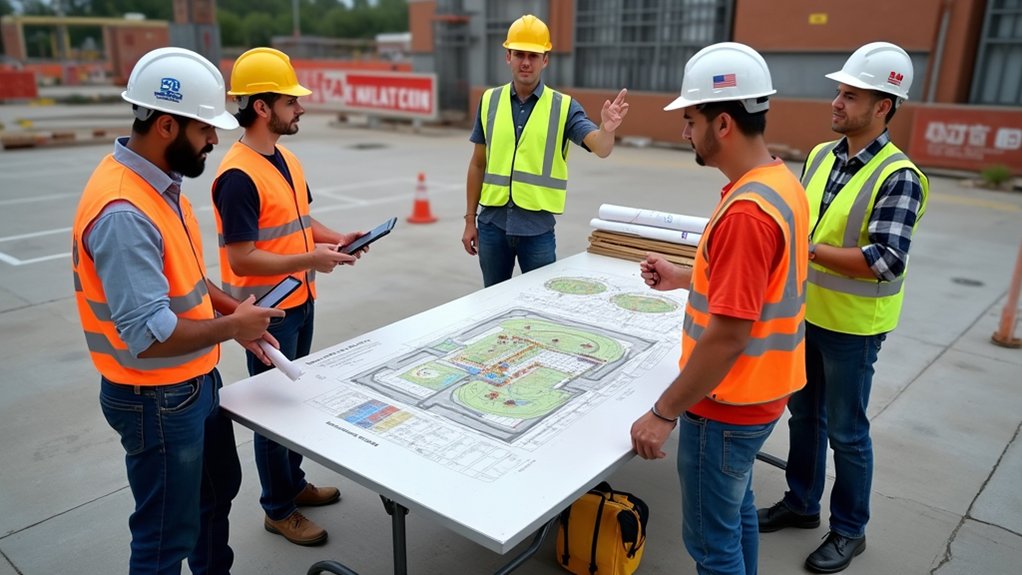
How do you keep multiple employers from running multiple “systems” on the same job? You mandate one site-specific safety plan and bind every subcontractor to it at contract award and mobilization. Require documented acknowledgement, task-level hazard analyses, and proof of training aligned to your controls.
Use subcontractor coordination meetings to map overlapping scopes, interface hazards, and permit needs (hot work, excavation, energized systems).
You standardize safety communication: one reporting line, one stop-work authority, one incident notification timeline, and one corrective-action tracker. Post uniform rules for PPE, access control, lifting zones, and traffic patterns, then enforce them through joint inspections and progressive discipline.
Verify compliance with daily pre-task briefings, badge checks, and equipment tagging. If a subcontractor’s program conflicts, you don’t “blend” it—you supersede it.
Frequently Asked Questions
How Do Safety Standards Affect Construction Insurance Premiums and Claims?
Safety standards slash premiums and simplify claims; safety-savvy sites see fewer losses. You document Safety training and perform Risk assessment, proving compliance. Insurers reward reduced risk, while violations trigger surcharges, exclusions, and denied payouts.
What Are Typical Penalties for Safety Violations During Construction?
You’ll typically face citations, stop-work orders, mandated abatement, and fines per violation/day; serious Equipment hazards can trigger willful/criminal penalties, debarment, or license suspension. If Training protocols lapse, expect higher assessments and enforced corrective-action plans.
Who Is Legally Liable for Subcontractor Safety Noncompliance?
You’re typically liable if you control the worksite; the subcontractor’s employer remains liable too. You must enforce Subcontractor accountability, verify Safety training, and document audits, contracts, and corrective actions to limit regulatory exposure.
How Often Should Safety Standards Be Reviewed for Regulatory Updates?
Review safety standards at least quarterly, and immediately after regulatory bulletins or incident trend changes. Tie updates to safety training refreshers and hazard identification reviews. Document revisions, approval dates, and communication logs to demonstrate compliance.
What Safety Documentation Must Be Retained After Project Completion?
You should retain key safety records; OSHA citations show poor recordkeeping contributes to ~10% of fines. Keep Safety training logs, hazard assessments, incident/near-miss reports, inspections, permits, exposure monitoring, equipment certifications, and regulatory correspondence, per mandated retention periods.